October 16, 2026
Why I love running a company as a user researcher
Building Stitchwork means I can act directly on what I learn from users, without having to convince anyone else. It's the shortest feedback loop I've ever had.
Analysing qualitative data is a fluid, exploratory process. In my research for Stitchwork, I've been learning how researchers work around the limitations of chat-based AI tools to make sense of their data.
· By Jake McCann
AI chat is linear. It’s designed for back-and-forth questions and answers. Even Claude Code, which represented a major breakthrough in “using AI to actually do stuff”, uses a chat-based approach.
But analysing qualitative research data isn’t a linear task. Consider affinity mapping. The process goes something like this: searching for individual quotes, noticing potential combinations of quotes, searching for more quotes that fit into those combinations, visualising those combinations by grouping quotes, naming the combinations, moving quotes between different combinations, combining combinations into further combinations, visualising those combined combinations by grouping them, naming the combined combinations…
Those steps don’t happen in a neat, linear sequence. You skip back and forth, loop through some steps, repeat others. It’s fluid, because that’s the way human brains make sense of complex information. So an interface for turn-based messaging isn’t going to be the best way to do that type of work.
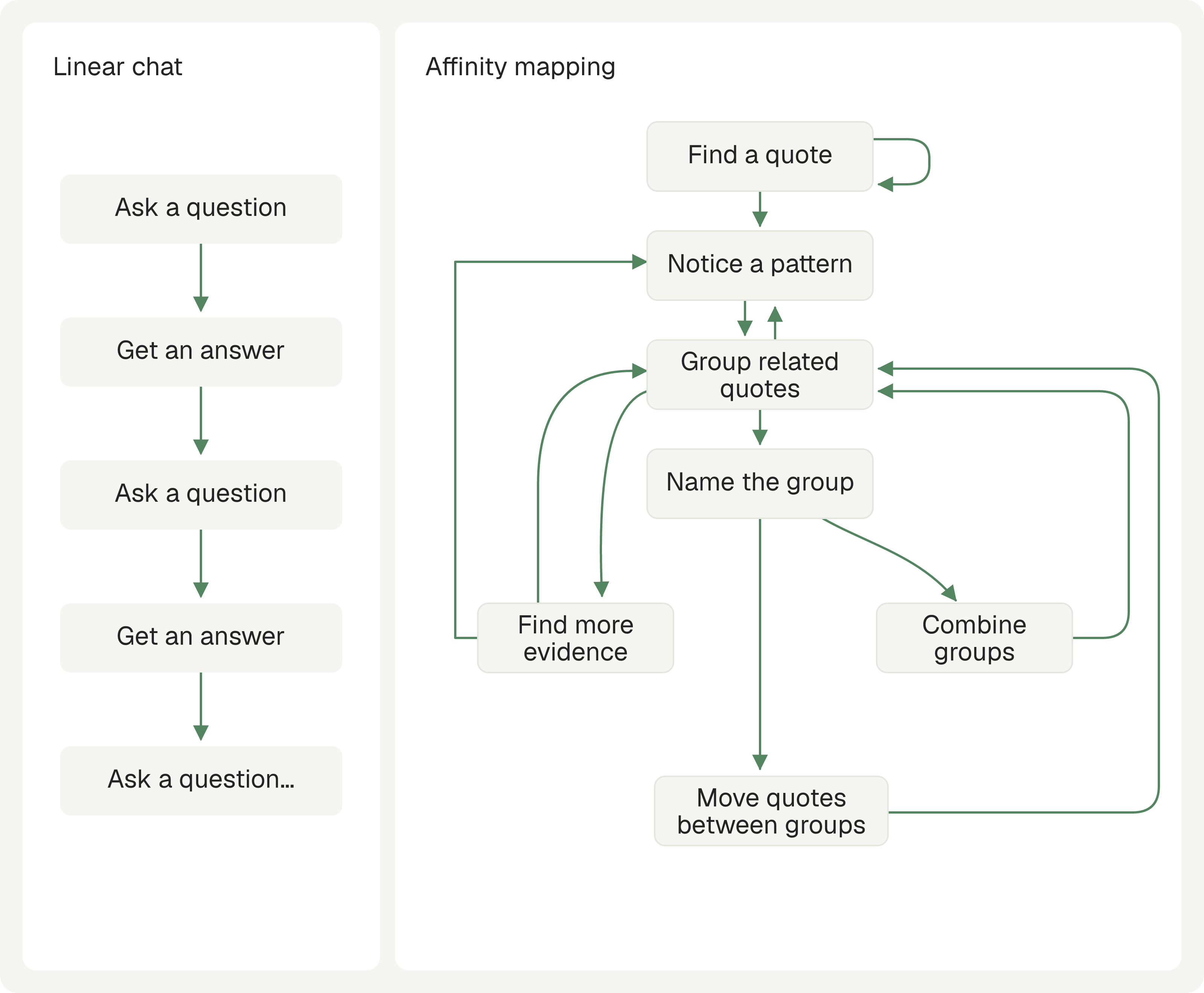
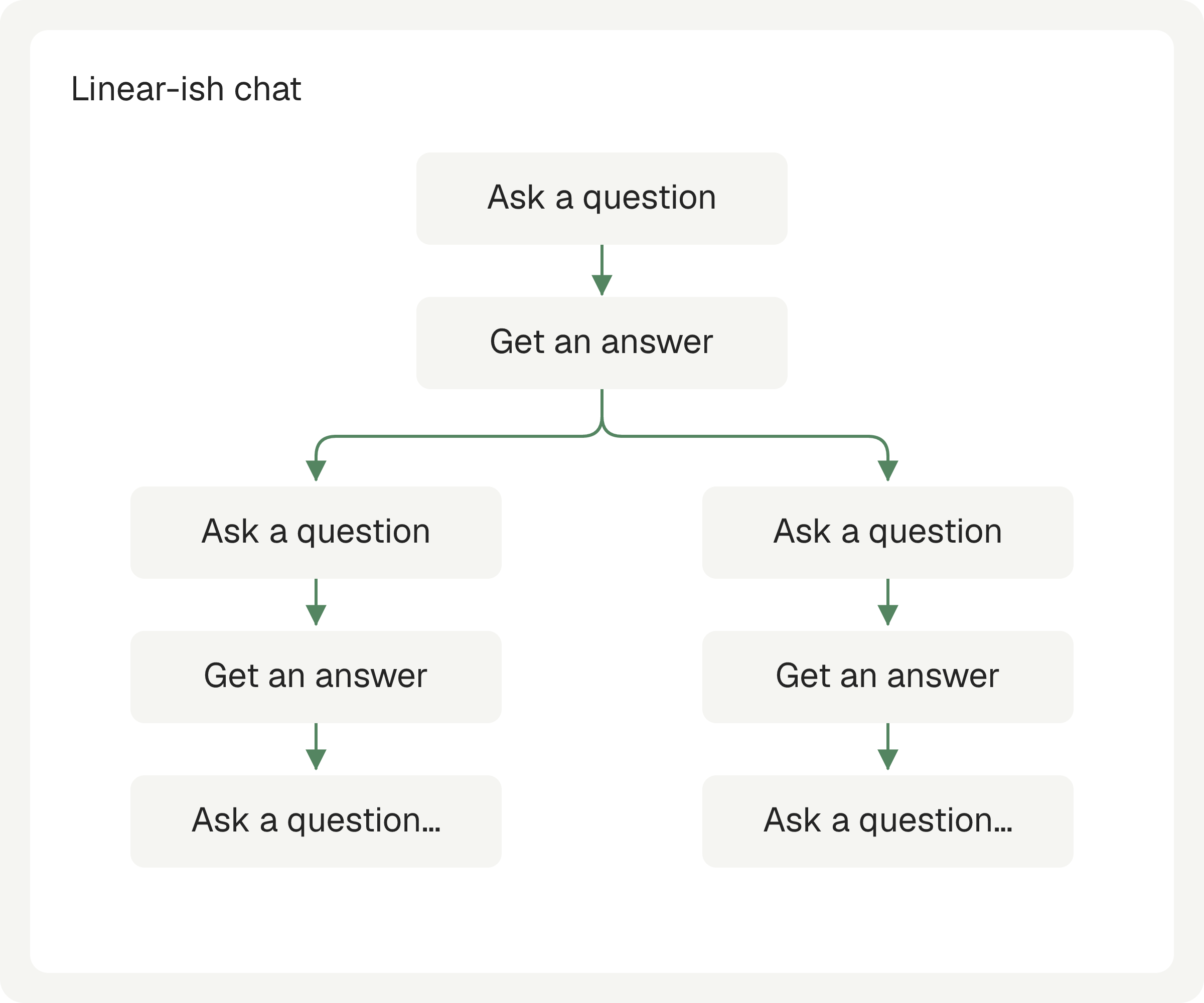
In practice, though, I’ve interviewed many researchers who only have access to AI via a chat interface. Many organisations have an approved general-purpose AI tool like Copilot, Gemini, ChatGPT or Claude. All of these allow you to point an AI assistant at a set of data and engage in a linear-ish analysis workflow. I say linear-ish as many AI chat tools these days allow you to branch the chat. This is useful for taking the chat in multiple different directions from a common starting point, but is cumbersome for the looping, branching, exploratory behaviour that is needed to support qualitative analysis.
Among the researchers I’ve spoken to, a common way to overcome this limitation is to move the data between different tools. An AI conversation might be helpful for spotting a pattern in the data or finding specific quotes. But the researcher then moves to a whiteboarding tool or spreadsheet to establish the details of the pattern, check the AI hasn’t made it up, and create the visual grouping and hierarchy that allow them to make sense of the data. Then they might upload screenshots or a CSV file of the groupings to the AI chat and have the AI give feedback and help refine the groupings.
In a way, it works okay. It’s kludgy, but there are deadlines, everyone is expecting you to use AI to speed up your work, and so needs must. And that’s to be expected. Every industry, every field, is in a phase where they’re trying to figure out how to work with AI. I suppose my bet is that we’ll look back in ten years and find it quaint how we all tried to do our jobs by having little conversations with the computer.
But in the meantime, many researchers are having to work around the limitations of the chat-based interface. If this sounds like you, I’d love to hear from you. You can reach me on jake@stitchwork.ing.
October 16, 2026
Building Stitchwork means I can act directly on what I learn from users, without having to convince anyone else. It's the shortest feedback loop I've ever had.
September 02, 2026
How to use Gemini Notebook to clean user research transcripts reliably, without the summarising and rewriting problems of ordinary AI chat.
March 03, 2026
Top-down categorisation leads to weaker analysis. Take a bottom-up approach instead, using three simple rules for group size, outliers, and labels.